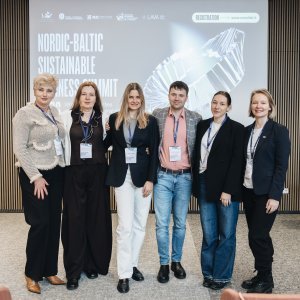
Key takeaways from the 13th Nordic-Baltic Sustainable Business Summit
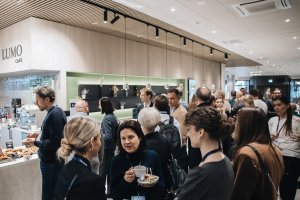
As governments increasingly prioritise defence, national security and economic competitiveness, sustainability is facing a changing political landscape. Climate commitments are being reconsidered, regulations are evolving, and public resources are
being directed towards new priorities.
Yet many businesses continue to invest in sustainability. What is driving their commitment when political priorities are shifting?
This question was at the centre of the 13th Nordic-Baltic Sustainable Business Summit, held on 13 November 2026 at SIMBIOCITY Nova in Vilnius. Organised by the Swedish, Estonian, Finnish and Norwegian Chambers of Commerce in Lithuania together with the Lithuanian Responsible Business Association (LAVA), the summit brought together business leaders, sustainability experts and representatives from the financial sector.
Throughout the day, discussions explored how sustainability remains connected to business competitiveness, resource efficiency, risk management and long-term resilience.
Turning sustainability into everyday business practice
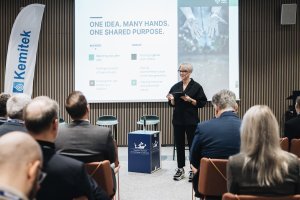
The summit opened with Vesa Nissinen, who presented “Leading Change That Lasts”. He emphasised that lasting change should not be treated as a temporary process, but as part of an organisation’s culture. Leaders must lead by example, remain open to honest feedback and create an environment where continuous learning is encouraged. According to Nissinen, leadership is ultimately reflected in people’s behaviour, and leaders must demonstrate their own willingness to learn if they want others to follow.
Maria Jobenius, Senior Sustainability Strategist at Scania, explained how sustainability has become part of the company’s DNA and why responsibility must extend beyond its own operations to the entire value chain.
She highlighted the importance of collaboration between manufacturers, transport providers and customers in reducing emissions. One example was Scania’s cooperation with IKEA to electrify a transport flow in Portugal, demonstrating how partnerships can help overcome practical challenges in the transition towards sustainable transport.
Scania also involves employees in its sustainability efforts through its annual Climate Day, when employees dedicate time to reflecting on how they can personally contribute to reducing emissions.
Marcin Gawroński, Director of the Green Building Department at Sweco Polska, explored why sustainability remains relevant despite economic uncertainty and shifting political priorities. He highlighted its connection to business resilience, energy independence, cost efficiency and access to capital. Drawing on research showing that 94% of surveyed companies had experienced financial losses from climate-related supply-chain disruptions, he emphasised that sustainability is not only an environmental responsibility, but also an important part of managing risks and remaining competitive.
Ana Paz, Head of Sustainability Reporting at Telia, shared how sustainability is integrated into the company’s everyday business operations. She highlighted the importance of creating a common understanding of sustainability across departments and connecting environmental and social objectives to existing business priorities, including security, privacy and resilience.
Rather than treating sustainability as a separate initiative, Telia incorporates it into business decisions, performance monitoring and cross-functional cooperation. During the panel discussion, Paz also described how device leasing and reuse can contribute to more circular business models.
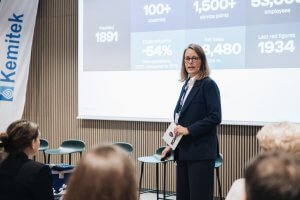
From compliance to competitiveness
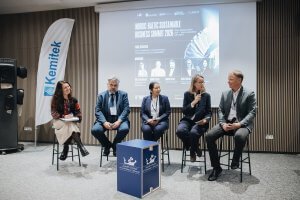
The first panel discussion, “From Compliance to Competitiveness: The Business Case for Sustainability”, brought together representatives from Scania, Telia, INHUS and DNV to explore how businesses can turn sustainability ambitions into practical results.
Audrius Tulaba, CEO of INHUS, shared how the construction company is integrating sustainability into material selection, manufacturing processes and more efficient use of resources. He also highlighted growing demand from Nordic customers for transparent calculations of construction projects’ carbon footprints.
An important question raised by the audience was: are customers willing to pay more for sustainable solutions? The discussion highlighted that sustainability must also make commercial sense, through greater efficiency, lower costs and long-term business value.
Audrius Šileika from DNV emphasised the importance of moving beyond reporting and certifications towards meaningful action.
The panel’s central message was clear: setting sustainability targets is only the beginning. What matters is turning ambitions into concrete actions and measurable results.
Sustainability in a changing geopolitical landscape
The second part of the summit explored how sustainability intersects with security, geopolitical uncertainty and long-term responsibility.
Simona Rasalė, CEO of Myliu Mišką, highlighted the importance of collective action and investing in a future whose benefits we may not experience ourselves. Her presentation emphasised that meaningful environmental change often requires cooperation and a
willingness to think beyond immediate results.
Guoda Lomanaitė-Juozapavičienė, ESG Manager at Nord Security, addressed common sustainability myths and the challenges companies face when translating long-term ambitions into practice. She highlighted that sustainability priorities may differ between businesses and that significant transitions require time and investment.
Rasma Saulė, CEO of HRX Lithuania, explored the relationship between sustainability and security in her presentation “Sustainable Logistics Under War Threats”. She highlighted how geopolitical conflicts disrupt supply chains, increase transport costs and contribute to higher emissions, using the rerouting of ships around Africa as an example.
She also addressed the challenge facing Europe’s transport sector: investing in greener technologies while preparing for growing security threats. Saulė emphasised that sustainability and security should not be seen as competing priorities, and that while the
costs of sustainable investments are often easy to calculate, the costs of failing to act may only become visible during a crisis.
Will capital continue to support sustainability?
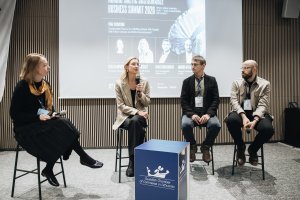
The final panel discussion, “Sustainable Finance in a Shifting World: Will Capital Still Follow Climate and ESG Commitments?”, was moderated by Vitalija Impolevičienė, Counsel at Sorainen.
The panel brought together Virginija Gelžinytė Gečienė from the European Investment Bank (EIB), Audrius Rutkauskas from SEB and Tadas Kavaliauskas from ILTE to discuss whether sustainability remains a priority for financial institutions.
Despite changes in political rhetoric and priorities, the panellists highlighted that sustainable financing continues to play an important role.
Audrius Rutkauskas, Baltic Head of Sustainability at SEB, highlighted the significant growth in green lending, explaining that SEB’s green financing has increased approximately 30 times. He also discussed the growing importance of credible transition plans when assessing financing opportunities, particularly for companies operating in high-emission sectors.
Virginija Gelžinytė Gečienė, Head of the EIB Group Office in Vilnius, highlighted how climate investments can support European competitiveness and technological development. Examples included investments in lower-emission steel production and innovative technologies, demonstrating how sustainability can contribute to industrial transformation.
Tadas Kavaliauskas, Chief Sustainability Officer at ILTE, discussed how sustainability considerations are integrated into financing decisions and how investments in areas such as battery energy storage can support both the green transition and national energy security. The discussion also addressed whether sustainable investments automatically receive more favourable financing conditions. The panellists explained that environmental performance is one consideration among several, alongside financial viability, credit risk and the specific requirements of different financing instruments.
A recurring theme was that sustainability, competitiveness and resilience are increasingly interconnected. Investments that reduce emissions can also improve energy independence, strengthen supply chains and support long-term economic stability.
Sustainability is evolving, not disappearing
The summit demonstrated that sustainability remains relevant to businesses for reasons that extend beyond political commitments and regulatory requirements. For some companies, sustainability means improving efficiency and reducing costs. For others, it means meeting customer expectations, managing risks, attracting investment or developing new technologies. As geopolitical tensions and security concerns reshape priorities, sustainability is also becoming increasingly connected to energy independence, resilience and competitiveness.
The discussions highlighted that the challenge is not simply to maintain sustainability commitments, but to ensure they translate into practical actions and long-term business value.
While political priorities may shift, the business reasons for investing in sustainability remain.
About the Nordic-Baltic Sustainable Business Summit 2026
The 13th Nordic-Baltic Sustainable Business Summit took place on 13 November 2026 at SIMBIOCITY Nova in Vilnius.
The event was organised by the Swedish Chamber of Commerce in Lithuania, Norwegian – Lithuanian Chamber of Commerce, Estonian Chamber of Commerce in Lithuania, Finnish-Lithuanian Chamber of Commerce and the Lithuanian Responsible Business Association (LAVA).
We would like to thank all speakers, panellists and participants for contributing to the discussions, as well as our fellow organisers for their collaboration.
Special thanks to our sponsors and supporters: Transcom, Sorainen, DNV, SIMBIOCITY Vilnius, Velox Entry, UAB KEMITEK and Urbanbee.lt.